A. PREHISTORY
Based on research by the Hagen artist Dietmar Schneider, the descendant of Simson Cohen (great-grandfather) and Arthur Levy (grandfather) found evidence in the Swiss Federal Archives in Bern in November 2019 that Simson Cohen transferred a dowry for the marriage of Arthur Levy to his daughter Erna Levy to his son-in-law to an account of the then Sparkasse Hagen (NRW, today Sparkasse an Volme und Ruhr) (early 1930s); the dowry was generous and represented a considerable sum.
Arthur Levy was a Swiss citizen and lived in Bern, Switzerland. Due to the discriminatory foreign exchange regulations in Germany in the 1930s, he was refused payment of his bank balance to Switzerland. Arthur Levy tried in vain to persuade the Swiss Foreign Ministry (now the FDFA) and the Swiss legation in Berlin at the time that Switzerland should intervene with the relevant authorities in Germany so that the assets could be transferred. However, the Swiss Foreign Ministry had asked Arthur Levy to prove himself that he needed the money due to an emergency (hardship case).
B. CONTACT WITH SPARKING CASH
The Sparkasse an Volme und Ruhr was therefore asked in writing by the descendant in November 2019 whether Arthur Levy still had a bank balance. In contradiction to the existing files, the Sparkasse expressly denied this and only confirmed that an account existed after the descendant filed a lawsuit with the Hagen Regional Court. Further files on the account balance were also found in the German state archives (including the Münster State Archives).
C. CLAIMS
Based on the response from the savings bank that no account existed, the descendant filed an action for information and performance with the Hagen Regional Court in relation to Arthur Levy’s bank balance. In its response, the savings bank confirmed the existence of the credit balance in the 1930s; however, the plea of the statute of limitations was raised (Currency Conversion Act, limitation periods under civil law).
The Savings Bank has also pointed out that Arthur Levy’s account was closed in 1937, for which there is no evidence on file. In addition, the Sparkasse has pointed out that the relevant files can no longer be found due to the Allied bombing; this claim has since been refuted by a historian. The archive of the former Sparkasse Hagen survived the bombing unscathed.
The Hagen Regional Court dismissed the descendant’s claim in its ruling of December 11, 2023 and essentially followed the savings bank’s explanations.
The Hagen District Court recently hit the headlines due to an acquittal in the NS trial against Siert Bruins.
The descendant has filed an appeal with the Hamm Higher Regional Court (NRW). At the appeal hearing on March 26, 2025, the Higher Regional Court (OLG) examined the limitation period for the claims against Sparkasse Hagen (an Volme und Ruhr) and came to the conclusion in a preliminary assessment that the limitation period had probably expired. The plaintiff’s applications (access to files, compensation) were therefore no longer subject to further review. The final judgment is expected on May 7.
D. DORMANT ASSETS
The Sparkasse Hagen (an Volme und Ruhr) has never made any inquiries about possible descendants of Arthur Levy who could make claims to the account balance. Even after being contacted by the descendant of Arthur Levy, the Sparkasse an Volme und Ruhr made no effort to enter into discussions with the descendant.
However, the study on dormant assets commissioned by the German government (Social Impact Fund) clearly states that all possible communication channels must be used to locate heirs to bank deposits.
This study also shows that up to this point the German savings banks are still obliged to disclose their accounting in relation to dormant assets.
It can be assumed that there are several billion euros of assets in so-called “dormant accounts” in Germany.
E. LEGAL ASSESSMENT
The legal case against Sparkasse Hagen (an Volme und Ruhr) is about clarifying which party has the burden of proof as to what exactly happened to Arthur Levy’s bank balance after it was blocked, what amount is still available, and who has to bear the consequences of a lack of evidence (from our point of view, the savings bank: if money is illegally withdrawn from a bank account by a third party, the bank must always prove what exactly happened to the balance!)
In its ruling of December 11, 2023, the Hagen Regional Court assumed on the basis of the savings bank’s statements that Arthur Levy’s account had been closed in 1937 and/or had been successively reduced, although there is no evidence of this on file.
The statements of the Hagen Regional Court on the question of the termination of the contractual relationship between the savings bank and Arthur Levy are also incomplete. In any case, this contractual relationship cannot have taken place with any kind of balancing of the account in question. Nothing is mentioned about a termination and the defendant savings bank has not submitted any evidence.
After the restoration of the rule of law in the then Federal Republic of Germany, the defendant bank had every reason and, in view of the continuing contractual relationship, every reason to inquire about the whereabouts of the plaintiff or descendants of Arthur Levy and to update the content of the account relationships. An obligation to secure the relevant bank documents already existed during the war.
The Hagen Regional Court also raised the question of whether it was an abuse of law for the savings bank to invoke the statute of limitations. In doing so, the court not only inadequately assessed the question of the continued existence of the contractual relationship, but also failed to take into account the reproachable conduct of the savings bank, in accordance with the Nazi doctrine at the time and therefore culpable.
The plea of the statute of limitations cannot be applied to this case of criminal expropriation of bank assets during the Nazi era (the result would be extremely unjust); the principle of good faith is therefore violated on the basis of Art. 242 BGB. Justice has no expiry date.
With regard to the application of the statute of limitations, Deutsche Bank has also confirmed to us in writing that inquiries about accounts of Jewish customers during the Nazi era are always investigated individually at this bank and that statutes of limitations do not play a role(confirmation from Deutsche Bank)
The behavior of the Sparkasse during the Nazi era is decisive; National Socialist injustice must always be justiciable. The Federal Republic of Germany has always attached particular priority to the moral and financial reparation of the injustices committed by the Nazi regime. Words must now be followed by deeds. The expropriation of the bank assets of Arthur Levy (grandfather of the plaintiff) is a National Socialist crime. Clarification and restitution of Nazi injustice are the raison d’être of the Federal Republic of Germany. Numerous banks in Germany still have accounts of Jewish owners that were expropriated during the Nazi era(Sparkasse Frankfurt, Banks during the Nazi Era, Dormant Assets).
The examination of the plaintiff’s claims against Sparkasse Hagen can therefore not be limited to possible limitation periods, irrespective of the fact that these are individual claims in civil proceedings. The savings bank’s objection that there was sufficient opportunity for claims to be made against the bank balance before the expiry of the limitation period (1979) contradicts the facts. Both the account holder Arthur Levy (Swiss citizen, died in 1954) and the plaintiff as descendant had already unsuccessfully requested the savings bank to provide information on the balance of the credit or to pay out the credit. Due to discriminatory Nazi regulations, Sparkasse Hagen had refused to pay Arthur Levy’s credit balance to Switzerland in the 1930s and informed the plaintiff in 2020 – before filing the lawsuit with the Hagen Regional Court – in writing and contrary to the existing files that there was no business relationship with Arthur Levy. The plaintiff was therefore not given a fair chance to assert his claim to the account balance of his grandfather Arthur Levy at the savings bank; as a result, according to applicable case law, it is not permissible to invoke the statute of limitations (good faith). The pre-litigation conduct of Sparkasse Hagen speaks against the statute of limitations.
F. PUBLICATION OF JEWISH FOLDERS
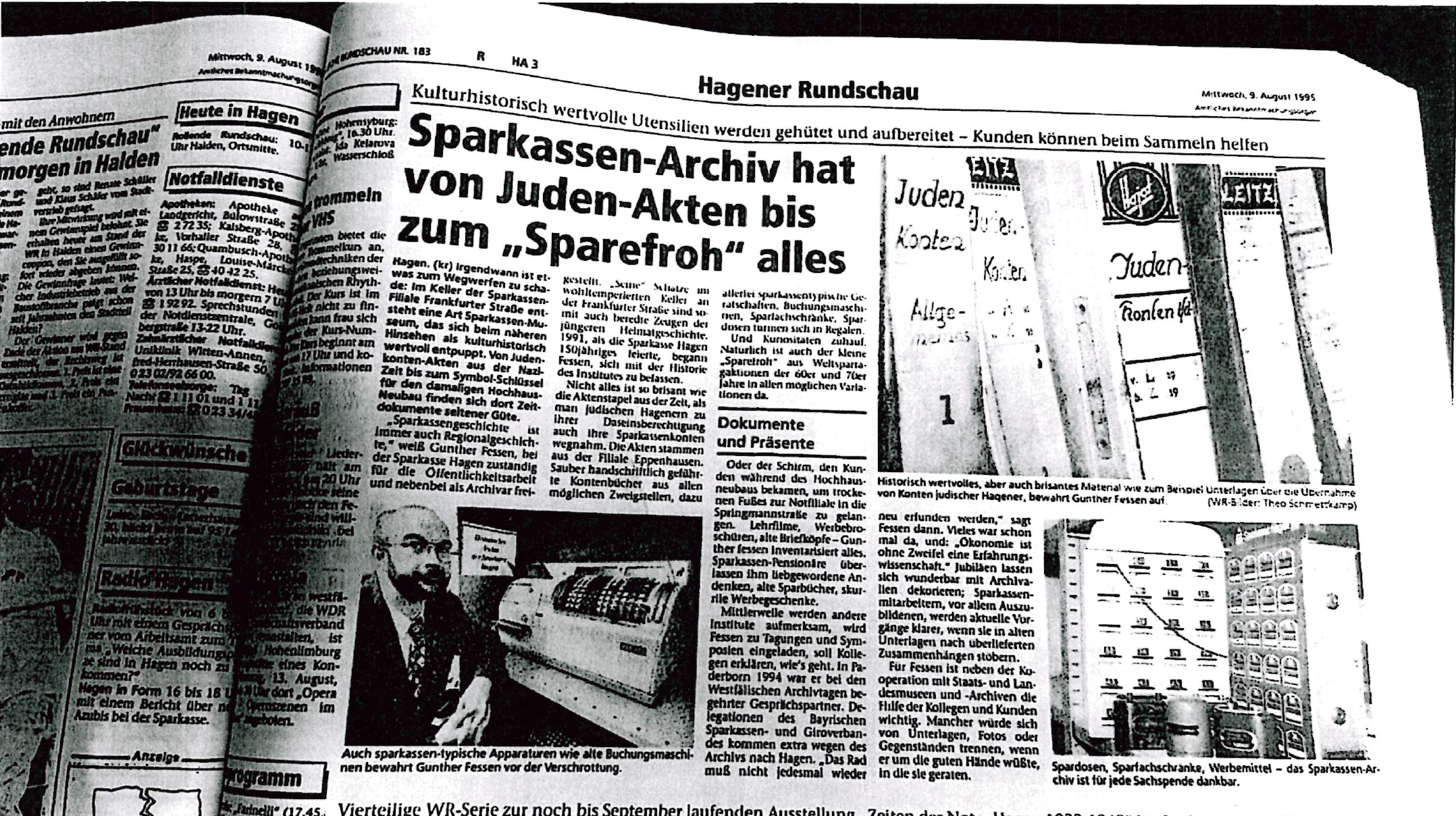
An article was published in the Westfalenschau newspaper on August 9, 1995, revealing that the Sparkasse Hagen (Sparkasse an Vollme und Ruhr) has historically valuable and explosive files on the expropriation of accounts belonging to Jewish citizens of Hagen in its archives Newspaper article Westfalenschau from August 9, 1995
The Sparkasse Hagen was therefore asked to inspect these files. Access has not yet been granted. Sparkasse Hagen has even filed an application with the Arnsberg Administrative Court to not have to release the files in accordance with the IFG NRW (Sparkasse Hagen application), arguing, among other things, that the request for the release of the files was not precise enough (requirement of certainty) and that the customer data of the Jewish account holders was protected by banking secrecy.
Such an argument is completely incomprehensible and is a mockery of the Jewish victims of expropriation during the Nazi era. Both the Jewish account holders and the heirs have an interest in complete transparency as to what happened to the spoliated assets, as well as an interest in appropriate compensation. Banking secrecy cannot be applied to these cases.